Hemoptysis (also spelled haemoptysis) means coughing up blood. Small streaks of blood in the sputum are common with chest infections, but heavy bleeding from the lungs is a medical emergency. Bronchial artery embolisation stops this bleeding from inside the blood vessel, through a needle puncture in the groin or wrist, without opening the chest. In many centres, including ours, vascular and endovascular surgeons perform it.
What is massive hemoptysis?
There is no single agreed definition. Doctors treat hemoptysis as massive, or life-threatening, when the amount of blood is large, when it affects breathing or when it makes the blood pressure fall. The main danger is to breathing rather than from blood loss. Because the airways hold only a small volume, blood that fills them stops oxygen from reaching the lungs.
A review in the Journal of Intensive Care estimated that 5 to 14% of people who come to hospital with hemoptysis have life-threatening bleeding, with reported death rates of 9 to 38% (Kathuria et al., 2020). For this reason, heavy bleeding needs hospital care straight away.
Why does the lung bleed?
The lungs have two blood supplies. The pulmonary arteries carry blood through the lungs at low pressure to pick up oxygen. The bronchial arteries, in contrast, are small branches of the aorta that nourish the airways at the higher pressure of the rest of the body. Long-standing inflammation makes the bronchial arteries enlarge and grow fragile new vessels, which can then rupture into the airways. The bronchial arteries are the source of bleeding in about 90% of cases (Kathuria et al., 2020).
In India, the commonest cause is tuberculosis and the lung damage it leaves behind. In a series of 187 patients who had bronchial artery embolisation in Jaipur, 84% had post-tuberculosis lung damage, 10% had bronchiectasis and 4% had an aspergilloma, a fungal ball growing in an old lung cavity (Mahla et al., 2021). Lung cancer and other infections are less common causes.
First steps in hospital
The first priority is to protect breathing. The team gives oxygen and, if they know which side is bleeding, positions the patient with that side down so that blood does not spill into the healthy lung. Blood tests check the blood count and clotting, and some patients need a breathing tube. A CT angiogram of the chest then shows where the bleeding is coming from and maps the arteries supplying that area, including arteries other than the bronchial arteries. In addition, a chest physician may examine the airways with a bronchoscope.
How bronchial artery embolisation is done
The procedure takes place in a catheterisation laboratory, usually under local anaesthesia. The surgeon passes a thin tube (catheter) through a needle puncture in the artery at the groin or wrist and guides it up to the aorta in the chest. Contrast dye then shows the bronchial arteries on X-ray. The artery responsible usually looks enlarged and twisted, with a blush of abnormal vessels in the bleeding part of the lung.
Next, the surgeon advances a finer microcatheter into that artery and injects tiny particles or a medical glue to block the abnormal vessels. The most commonly used agent is polyvinyl alcohol particles of 300 to 600 micrometres (Panda et al., 2017). The lung tissue survives because it still receives blood from the pulmonary arteries. The surgeon also checks other arteries that can feed the same area, such as branches of the intercostal or internal thoracic arteries, and treats them in the same sitting if needed.
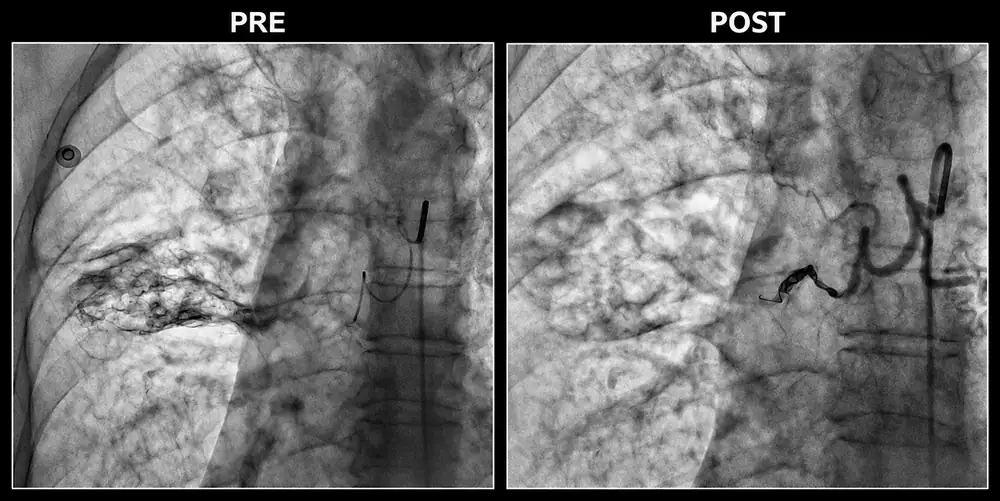
Before blocking any artery, the surgeon examines the angiogram for a small branch that supplies the spinal cord, which sometimes arises from the same trunk as a bronchial artery. If one is present, the surgeon moves the catheter beyond it or leaves that artery alone. This check is the most important safety step in the procedure.
Bronchial artery embolisation by vascular and endovascular surgeons
Bronchial artery embolisation is an endovascular procedure, carried out entirely from inside the arteries. Vascular and endovascular surgeons train in angiography and embolisation of arteries throughout the body, and use the same skills to stop bleeding in the gut and to treat vascular malformations. Dr. Aniruddha Bhuiyan, an MCh vascular and endovascular surgeon, performs bronchial artery embolisation in Mumbai, working alongside the chest physician and intensive care team.
Results of bronchial artery embolisation
The procedure stops the bleeding straight away in most patients. A systematic review of 22 studies reported immediate success rates of 70 to 99% (Panda et al., 2017). In the Jaipur series, bleeding had stopped completely within 24 hours in 97.8% of patients (Mahla et al., 2021).
However, bleeding can come back, because the underlying lung disease remains and new vessels can form. The same review found recurrence rates of 10 to 57%, with higher rates in people with an aspergilloma, reactivated or drug-resistant tuberculosis, or feeding arteries from outside the bronchial circulation. A second embolisation can often treat recurrent bleeding. Treating the cause also helps prevent further bleeding, whether with anti-tuberculosis treatment, antifungal medicines or, in selected patients, surgery to remove the diseased part of the lung.
Risks of bronchial artery embolisation
Chest discomfort for a few days is common, and some people have temporary difficulty swallowing. There may also be bruising where the catheter entered. Serious complications are rare, with a median rate of major complications of 0.1% in the systematic review (Panda et al., 2017). The most serious is injury to the blood supply of the spinal cord, which can cause weakness of the legs. It occurred in 2 of the 187 patients in the Jaipur series (Mahla et al., 2021).
Recovery after bronchial artery embolisation
Patients stay under close watch in hospital, usually in an intensive care or high-dependency unit at first. The puncture site needs a few hours of rest. Most people can eat and walk the next day, and the total hospital stay depends mainly on the underlying lung condition. Follow-up with the chest physician and the vascular surgeon continues after discharge.
When to seek help
Coughing up blood always needs a medical assessment. Go to the nearest hospital emergency department straight away if you cough up more than a few spoonfuls of blood, if the bleeding keeps coming back, or if you feel breathless, dizzy or faint.
Frequently asked questions
Is bronchial artery embolisation an operation?
There is no cut in the chest. The surgeon works through a needle puncture in the groin or wrist, usually under local anaesthesia, and guides a catheter to the bleeding artery on X-ray.
Is bronchial artery embolisation painful?
Local anaesthetic numbs the puncture site. Chest discomfort for a few days afterwards is common and settles with simple painkillers.
Can the bleeding come back after embolisation?
Yes, in some patients, especially when the lung disease is still active. Repeat embolisation is possible, and treating the underlying cause lowers the risk.
Who performs bronchial artery embolisation?
Doctors trained in endovascular procedures perform it, including vascular and endovascular surgeons and interventional radiologists. At our practice, vascular and endovascular surgeons perform it.
Book a consultation
For assessment of recurrent hemoptysis or a second opinion on bronchial artery embolisation, call +91 77383 27001 or book an appointment with Dr. Aniruddha Bhuiyan at Vascular Care n Cure Clinic, Andheri East, Mumbai. In an emergency, go to the nearest hospital emergency department.
References
- Kathuria H, Hollingsworth HM, Vilvendhan R, Reardon C. Management of life-threatening hemoptysis. J Intensive Care. 2020;8:23. doi:10.1186/s40560-020-00441-8
- Mahla H, Kunal S, Sharma SK, Mahla R, Jain A, Sharma SM. Bronchial artery embolization: a gratifying life-saving procedure. Indian J Tuberc. 2021;68(1):40-50. doi:10.1016/j.ijtb.2020.09.019
- Panda A, Bhalla AS, Goyal A. Bronchial artery embolization in hemoptysis: a systematic review. Diagn Interv Radiol. 2017;23(4):307-317. doi:10.5152/dir.2017.16454
