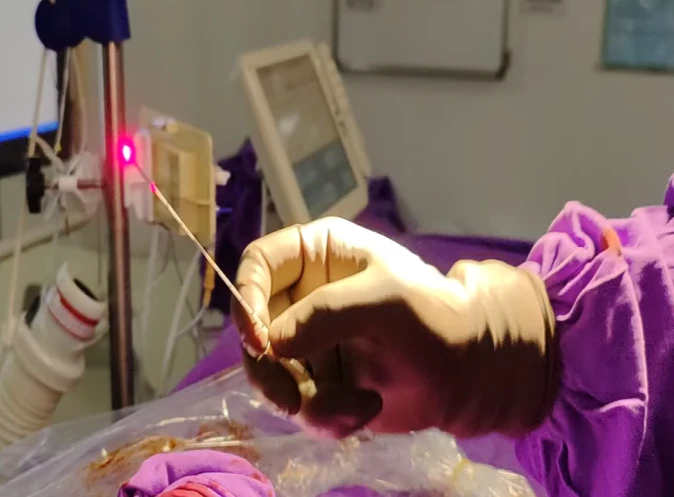
Most people who need treatment for varicose veins today do not need open surgery. The leaking vein can be closed from the inside through a needle puncture under local anaesthesia, and you walk out the same day.
There are three established ways to close the vein: laser, radiofrequency and medical glue. A fourth, microwave ablation, is newer. All of them work well. They differ in how the vein is closed, how much local anaesthetic is needed, whether you wear stockings afterwards and what they cost. This article explains those differences so you can discuss them with your surgeon.
It starts with a duplex scan
The bulging veins you can see are usually branches. The source is often a leaking valve higher up, most commonly where the great saphenous vein joins the deep vein in the groin, or where the small saphenous vein joins it behind the knee. A duplex ultrasound scan shows which veins carry blood backwards and how far the leak extends. That map decides the treatment.
Not every varicose vein needs a procedure. Treatment is worth considering if aching, heaviness, swelling or night cramps affect your daily life, if the skin around the ankle has darkened or hardened, or if you have had an ulcer or bleeding from a vein.
What the treatments have in common
Each one is a day-care procedure. Guided by ultrasound, the surgeon passes a thin catheter or fibre into the faulty vein, usually through a puncture near the knee or ankle, and places its tip just below the junction with the deep vein. The vein is then closed along its length. Blood that used to pool in it reroutes through the healthy deep veins, which already carry most of the blood out of the leg. There is no cut in the groin and no stitches.
Laser ablation (EVLA)
A laser fibre heats the vein wall from inside as it is slowly withdrawn, and the vein shrinks and seals. Before the laser is switched on, dilute local anaesthetic is injected around the vein along its length. This is called tumescent anaesthesia. It numbs the area, squeezes the vein onto the fibre and protects the skin and nearby nerves from the heat.
Laser is the most widely used method and has the longest track record. Current laser wavelengths and fibres cause less bruising and pain than the early machines did. Expect some tightness and bruising along the inner thigh for a week or two.
Radiofrequency ablation (RFA)
Radiofrequency works on the same principle, but the catheter heats the vein wall with radiofrequency energy in short segments at a controlled temperature. It also needs tumescent anaesthesia. Closure rates and recovery are similar to modern laser, and the choice between the two often comes down to the surgeon’s experience and the equipment available.
Medical glue (cyanoacrylate closure)
Glue closure uses no heat. Small amounts of a medical adhesive are placed along the vein while the surgeon presses on the skin to hold the vein walls together. Because there is no heat, the tumescent injections along the thigh are not needed. Only the entry point is numbed, and many patients do not need compression stockings afterwards.
In the VeClose trial, which compared glue with radiofrequency, 91.4% of the glue-treated veins and 85.2% of the radiofrequency-treated veins were still closed at five years. Some people develop an itchy, red, tender reaction along the treated vein a few days after glue treatment. It usually settles on its own or with anti-inflammatory tablets. Glue is not used in people with a known allergy to cyanoacrylate, and in most centres the glue system costs more than laser or radiofrequency.
Microwave ablation
Microwave ablation is a newer heat-based method that closes the vein in the same way as laser and radiofrequency. Early results are encouraging, but there is less long-term evidence for it than for the other three methods. It is offered at our clinic for selected patients.
How the options compare
| Laser (EVLA) | Radiofrequency (RFA) | Glue | |
|---|---|---|---|
| Heat used | Yes | Yes | No |
| Local anaesthetic | Injections along the vein | Injections along the vein | One injection at the entry point |
| Walking | Same day | Same day | Same day |
| Back to desk work | 1 to 3 days | 1 to 3 days | Often the next day |
| Compression stockings | Usually 2 to 4 weeks | Usually 2 to 4 weeks | Often not needed |
| Common after-effects | Bruising and tightness along the thigh | Bruising and tightness along the thigh | Itchy, red reaction along the vein in some people |
| Relative cost | Lower | Similar to laser | Higher |
These are typical figures. Your own recovery depends on how many veins are treated and on your general health.
Risks
Serious complications are uncommon with all of these methods. Afterwards you may notice bruising, tenderness along the treated vein or a firm cord under the skin that softens over a few weeks. Small patches of numbness can follow heat treatment when the vein runs close to a skin nerve, which is more likely below the knee. A clot that extends from the treated vein into a deep vein (deep vein thrombosis) is rare, and a follow-up ultrasound scan checks for it.
What happens to the bulging veins on the surface?
Closing the main leaking vein removes the pressure that feeds the surface branches, and many of them shrink. Larger branches can be removed through tiny nicks in the skin (phlebectomy) or treated with foam sclerotherapy, either in the same session or a few weeks later.
Can varicose veins come back?
A vein that has been closed successfully usually stays closed. New varicose veins can still form in other veins over the years, because the underlying tendency remains. Regular walking and a healthy weight help, and a check-up scan picks up new reflux early.
Which treatment is right for you?
For most people with a leaking saphenous vein, heat-based ablation with laser or radiofrequency is the established first choice. The UK’s National Institute for Health and Care Excellence (NICE) recommends endothermal ablation first, foam sclerotherapy if ablation is unsuitable, and surgery only if neither is suitable. The European Society for Vascular Surgery’s 2022 guideline also prefers endovenous ablation to open surgery for the saphenous veins.
Glue is a good alternative if you would rather avoid the tumescent injections or stockings, or when the vein runs close to a nerve below the knee, where heat carries a higher risk of numbness. The final choice depends on the scan, the size and course of the vein, your other medical conditions and the cost.
Book a consultation
Dr. Aniruddha Bhuiyan is an MCh vascular and endovascular surgeon who treats varicose veins with laser, radiofrequency, glue and microwave ablation. He consults at Vascular Care n Cure Clinic in Andheri East, Mumbai. Call +91 77383 27001 or book an appointment to have your veins scanned and your options explained. You can read more about the condition, its causes and its symptoms on our varicose veins page.
References
- National Institute for Health and Care Excellence. Varicose veins: diagnosis and management. Clinical guideline CG168. 2013. nice.org.uk/guidance/cg168
- De Maeseneer MG, Kakkos SK, Aherne T, et al. European Society for Vascular Surgery (ESVS) 2022 clinical practice guidelines on the management of chronic venous disease of the lower limbs. Eur J Vasc Endovasc Surg. 2022;63(2):184-267. doi:10.1016/j.ejvs.2021.12.024
- Morrison N, Gibson K, Vasquez M, et al. Five-year extension study of patients from a randomized clinical trial (VeClose) comparing cyanoacrylate closure versus radiofrequency ablation for the treatment of incompetent great saphenous veins. J Vasc Surg Venous Lymphat Disord. 2020;8(6):978-989. doi:10.1016/j.jvsv.2019.12.080
