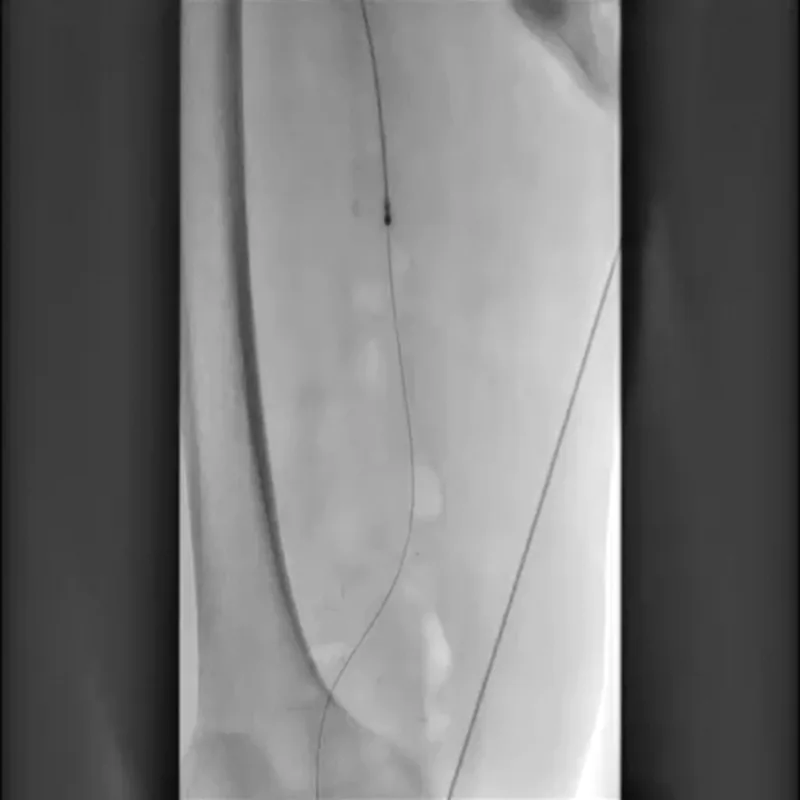
“Doctor, should I get atherectomy?” I hear this question a lot these days. A relative may have had it, a hospital may have advertised it, or another doctor may have suggested it.
So what is it? Atherectomy is a way of clearing plaque from a blocked artery from the inside. A tiny tool on the end of a thin tube shaves, sands or breaks down the plaque. The idea is not new, but the devices have improved a lot in recent years.
This article explains how atherectomy differs from a plain balloon, and when it really helps. It is about blockages in the leg arteries. For the basics of leg artery disease, first read my page on leg artery blockages and diabetic foot.
First, how does a plain balloon work?
Today, doctors open most leg artery blockages through a needle puncture instead of an open operation. The simplest method is balloon angioplasty. Doctors often call it POBA, short for plain old balloon angioplasty.
First, we pass a thin guidewire across the blockage, usually through the artery in the groin. Then we slide a deflated balloon over the wire, place it inside the narrowing and inflate it for a minute or two.
The balloon does not remove anything. Instead, it squashes the plaque against the wall, stretches the artery and makes small cracks in the plaque. For soft plaque this works well. In fact, a balloon is still part of almost every procedure.
Why a plain balloon sometimes struggles
However, the trouble starts when the plaque is hard. In people with diabetes or kidney disease, and in many older people, calcium builds up in the artery wall. On an X-ray you can often see it outlining the artery like a chalk line. Pushing a balloon against this calcium is like pushing against a ring of stone, so a few things can go wrong.
- The balloon does not open fully. It stays pinched in the middle, so the narrowing remains. The usual answer is more pressure, which leads to the next problem.
- The artery tears. At high pressure, hard plaque can split unevenly and lift the inner lining of the artery. Doctors call this a dissection. A large one can block the flow again, and the usual fix is a stent.
- The artery springs back. The artery loses part of the stretch within minutes, so the result looks only half done.
There is one more problem. Today we often finish with a drug-coated balloon, which leaves a medicine on the artery wall to slow down re-narrowing. However, calcium can act as a barrier to that medicine. In a small study from Rome, drug-coated balloons worked less well when calcium went most of the way around the artery (Fanelli et al., 2014).
So what is atherectomy?
Atherectomy means removing or reshaping plaque from inside the artery. The word comes from atheroma, the medical name for plaque, and “ectomy”, which means cutting out. The device runs over the same thin wire as a balloon, through the same small puncture. However, instead of only pushing the plaque aside, it shaves, drills or sands it, or breaks it down with laser light.
That is why doctors call this vessel preparation or plaque modification. On its own, atherectomy is rarely the whole treatment. Its job is to soften or debulk the plaque. After that, a balloon, often a drug-coated balloon, can open the artery at low pressure. The hope is less tearing, less recoil and fewer stents.
The newer atherectomy devices
There are four main types of atherectomy device. Each one works differently, so the choice depends on the kind of plaque, where it sits and how long the blockage is.
Directional atherectomy: the shaver
A small spinning blade sits inside a window on one side of the catheter. We turn the window towards the plaque and pass the device through the narrowing several times, shaving off thin slices. The shavings collect in the nose of the catheter and come out with it. Because it cuts on one side, it suits plaque that sits more on one side of the artery. HawkOne is a common example. Pantheris also adds a tiny imaging probe at the tip, so the operator can see the artery wall while cutting.
Rotational atherectomy: the drill with suction
A cutting head at the front of the catheter spins at high speed and moves forward through the blockage. Some of these devices also suck out the loose bits and any clot as they go. For example, Jetstream and Rotarex work this way. They are useful when the blockage contains soft plaque or clot, including blockages that form inside an old stent.
Orbital atherectomy: the sander
Here a small crown coated with diamond grit sits a little off-centre on a spinning shaft. As it spins, it swings out in a circle and sands down hard calcium. The idea is that soft, healthy wall flexes away from the crown, while hard calcium does not. In addition, faster spinning gives a wider circle. The sanded particles are very fine, so the blood carries them away. Diamondback 360 is the best-known device, and its main use is heavy calcium.
Laser atherectomy: the light
A laser catheter sends very short pulses of light that break plaque down into tiny particles, without any blade. The excimer laser has been around for many years, while Auryon is a newer type of laser. Doctors often use laser to cross long, stubborn blockages. It also works well for blockages that form inside an old stent.
Not atherectomy, but in the same family
Two other tools also prepare hard plaque, even though they remove nothing.
Intravascular lithotripsy (IVL) borrows its idea from the treatment of kidney stones. A balloon carries small emitters that send out pressure waves. These waves crack the calcium inside the artery wall while the balloon sits at low pressure. Shockwave is the best-known system.
Scoring and cutting balloons carry thin wires or tiny blades on their surface. When inflated, they make neat cracks along the plaque instead of random tears.
Balloon, atherectomy or lithotripsy at a glance
| Plain balloon (POBA) | Atherectomy | Lithotripsy (IVL) | |
|---|---|---|---|
| How it works | Stretches and squashes the plaque | Removes or sands down the plaque | Cracks calcium with pressure waves |
| Best suited to | Soft, short blockages | Hard or bulky plaque, blockage inside an old stent | Heavy calcium |
| Risk of a tear (dissection) | Higher when there is calcium | Lower | Lower |
| Debris going downstream | Low | Possible; a filter may help | Low |
| Cost | Lowest | High | High |
What the studies show
This is where I want to be honest with you. The newer devices clearly make the result look better on the X-ray screen on the day. Whether the artery stays open for longer is a different question, and the answer is less clear.
In 2020, a Cochrane review pooled the randomised trials that compared atherectomy with balloon angioplasty. It found no clear difference in how many arteries stayed open at 6 and 12 months. Atherectomy did seem to cause fewer tears and needed fewer emergency stents. However, the trials were small, and the reviewers rated the evidence as very low certainty (Wardle et al., 2020).
A small trial called COMPLIANCE 360 shows the pattern well. In hard, calcified arteries of the thigh, orbital atherectomy let doctors open the balloon at about 4 atmospheres of pressure, compared with 9 for the balloon alone. Only 2 of 38 treated blockages needed a stent, against 21 of 27 in the balloon group. At one year, though, re-narrowing was about the same in both groups (Dattilo et al., 2014).
The DEFINITIVE AR study tested directional atherectomy before a drug-coated balloon. Serious tears were far less common with atherectomy (2% against 19%). At one year, however, the arteries were no more open than with the drug-coated balloon alone. Also, the study was too small to settle the question (Zeller et al., 2017).
Where the evidence is stronger
The clearest benefit is for blockages inside an old stent. In the EXCITE ISR trial of 250 patients, laser followed by a balloon did better than the balloon alone. At 6 months, 73.5% of the laser group had not needed a repeat procedure, compared with 51.8% of the balloon group (Dippel et al., 2015).
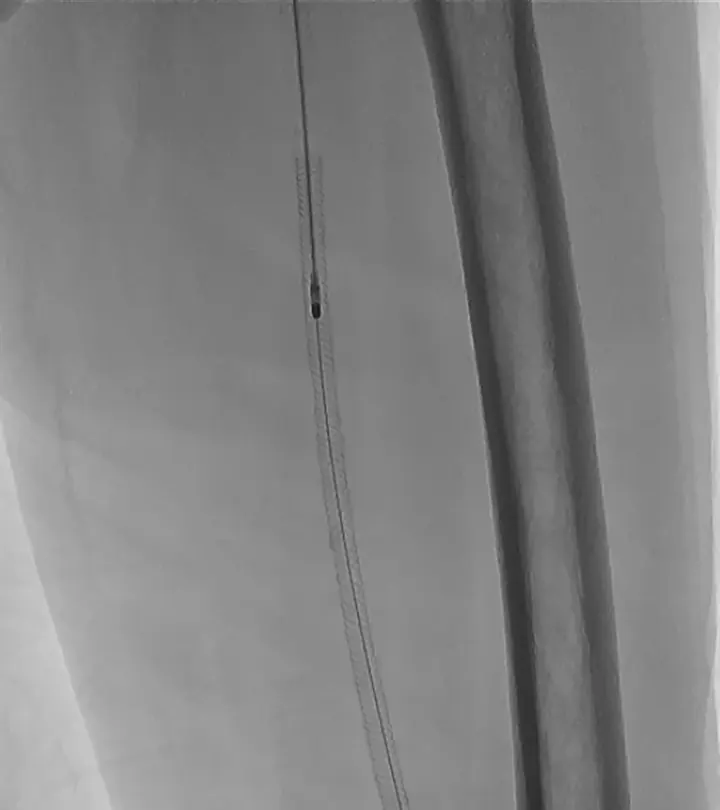
Lithotripsy has one of the larger trials in heavy calcium. In Disrupt PAD III, 306 patients with calcified thigh arteries had either lithotripsy or a plain balloon before the final drug-coated balloon or stent. The lithotripsy group needed fewer stents (4.6% against 18.3%). More of their arteries were also still open at 2 years (70.3% against 51.3%). Part of that gap comes from the trial rules, which counted an emergency stent in the balloon group as a failure (Tepe et al., 2021; Tepe et al., 2022).
A reason for caution
Large real-world data also urge caution. A US study of almost 17,000 patients found a higher risk of amputation after atherectomy than after a balloon alone or a stent (Ramkumar et al., 2019). A study like this cannot prove that the device caused the harm, because doctors tend to use atherectomy for the worst arteries. Still, it is a good reason not to use atherectomy as a routine.
The downsides
- Cost. The devices are single-use and expensive, so the bill is clearly higher than for a balloon alone.
- Debris. Bits of plaque can travel downstream and block the small arteries of the foot. With some devices we place a small filter below the treated area to catch them.
- Perforation. Rarely, the device can make a hole in the artery wall. Most of these holes can be sealed from inside with a balloon or a covered stent.
- Time and skill. The procedure takes longer and needs an operator who uses these devices regularly.
Who may benefit?
Atherectomy makes the most sense in a few situations:
- a heavily calcified artery that a balloon alone is unlikely to open well
- a blockage that has formed inside a stent placed earlier
- a blockage at the hip crease or behind the knee, where the artery bends with every step and we prefer not to leave a stent
- bulky plaque that needs debulking before a drug-coated balloon
On the other hand, it usually adds little for short, soft blockages, which open well with a balloon alone. When the disease is very long or the arteries are badly damaged, bypass surgery may still be the better choice. In people with diabetes, the exact artery that feeds a foot wound also matters, as I explain in my post on the angiosome concept.
Questions to ask before the procedure
Atherectomy is a tool, not a treatment plan. The real question is not “Do I need atherectomy?” but “What will give my leg good blood flow for the longest time?” So if you have been advised atherectomy, it is fair to ask:
- Why does my blockage need atherectomy and not a balloon alone?
- Which device will you use, and what comes after it: a balloon, a drug-coated balloon or a stent?
- How much will the device add to the cost?
- Is a vascular surgery team on hand if something goes wrong?
Whatever the procedure, the basics still matter most. Stop smoking completely, and keep your sugar, blood pressure and cholesterol under control. Also take your blood thinner and statin as advised, and walk every day.
Frequently asked questions
Is atherectomy painful?
We do it through a needle puncture, usually under local anaesthesia, sometimes with light sedation. Most people feel pressure rather than pain, and many go home within a day or two.
Is atherectomy better than balloon angioplasty?
Not for every blockage. It helps when the plaque is hard, bulky or inside an old stent. For short, soft blockages, a balloon alone works well. Studies have not shown that atherectomy keeps arteries open longer in general.
Will atherectomy mean I do not need a stent?
It can lower the chance of needing a stent, especially in calcified arteries. Still, nobody can promise a stent-free result before the procedure.
Is atherectomy also done in the heart?
Yes. Cardiologists use rotational and orbital atherectomy, laser and lithotripsy in calcified heart arteries. This article is about the leg arteries.
How soon can I walk after atherectomy?
Most people walk the same day or the next morning, once the puncture site has sealed. If there is a wound on the foot, healing takes weeks and needs regular dressings and follow-up.
Book a consultation
If you have been told you need atherectomy or angioplasty for a leg artery blockage and want a second opinion, call +91 77383 27001 or book an appointment with Dr. Aniruddha Bhuiyan at Vascular Care n Cure Clinic, Andheri East, Mumbai.
References
- Dattilo R, Himmelstein SI, Cuff RF. The COMPLIANCE 360° Trial: a randomized, prospective, multicenter, pilot study comparing acute and long-term results of orbital atherectomy to balloon angioplasty for calcified femoropopliteal disease. J Invasive Cardiol. 2014;26(8):355-60. PubMed 25091093
- Dippel EJ, Makam P, Kovach R, et al. Randomized controlled study of excimer laser atherectomy for treatment of femoropopliteal in-stent restenosis: initial results from the EXCITE ISR trial. JACC Cardiovasc Interv. 2015;8(1 Pt A):92-101. doi:10.1016/j.jcin.2014.09.009
- Fanelli F, Cannavale A, Gazzetti M, et al. Calcium burden assessment and impact on drug-eluting balloons in peripheral arterial disease. Cardiovasc Intervent Radiol. 2014;37(4):898-907. doi:10.1007/s00270-014-0904-3
- Ramkumar N, Martinez-Camblor P, Columbo JA, et al. Adverse events after atherectomy: analyzing long-term outcomes of endovascular lower extremity revascularization techniques. J Am Heart Assoc. 2019;8(12):e012081. doi:10.1161/JAHA.119.012081
- Tepe G, Brodmann M, Werner M, et al. Intravascular lithotripsy for peripheral artery calcification: 30-day outcomes from the randomized Disrupt PAD III trial. JACC Cardiovasc Interv. 2021;14(12):1352-1361. doi:10.1016/j.jcin.2021.04.010
- Tepe G, Brodmann M, Bachinsky W, et al. Intravascular lithotripsy for peripheral artery calcification: mid-term outcomes from the randomized Disrupt PAD III trial. J Soc Cardiovasc Angiogr Interv. 2022;1(4):100341. doi:10.1016/j.jscai.2022.100341
- Wardle BG, Ambler GK, Radwan RW, Hinchliffe RJ, Twine CP. Atherectomy for peripheral arterial disease. Cochrane Database Syst Rev. 2020;9:CD006680. doi:10.1002/14651858.CD006680.pub3
- Zeller T, Langhoff R, Rocha-Singh KJ, et al. Directional atherectomy followed by a paclitaxel-coated balloon to inhibit restenosis and maintain vessel patency: twelve-month results of the DEFINITIVE AR study. Circ Cardiovasc Interv. 2017;10(9):e004848. doi:10.1161/CIRCINTERVENTIONS.116.004848
